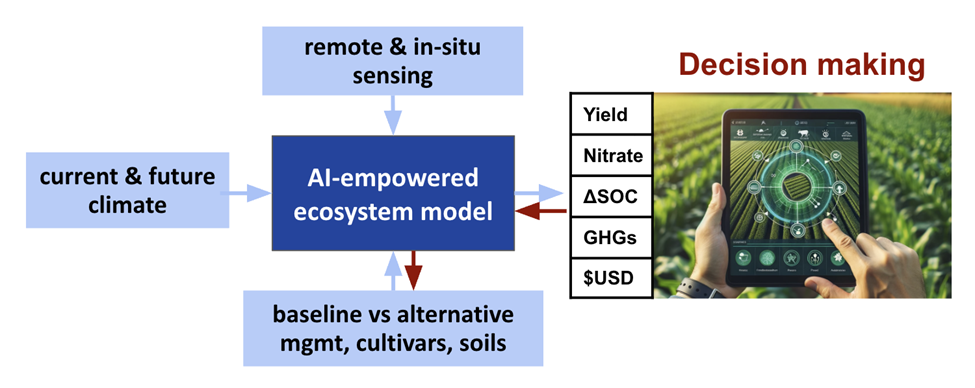
Continuously improve the holistic understanding of the carbon-nutrient-water-thermal nexus in the global agroecosystem systems to provide practical strategies for climate change mitigation. By integrating multi-source direct and indirect observations from cross-scale sensing techniques, such as low-cost sensors, UAVs, Lidar, and satellite data, with refined process-based and KGML models, this research aimsto provide a more accurate and comprehensive assessment of GHG sources and sinks, carbon and nutrient leaching to streamflow, and influences of various management practices in agroecosystems. This work will advance interdisciplinary collaboration, drive innovation in carbon-nutrient-water-thermal cycle research, and bridge the gap between theoretical models and practical climate solutions, offering valuable tools for policymakers and land managers.
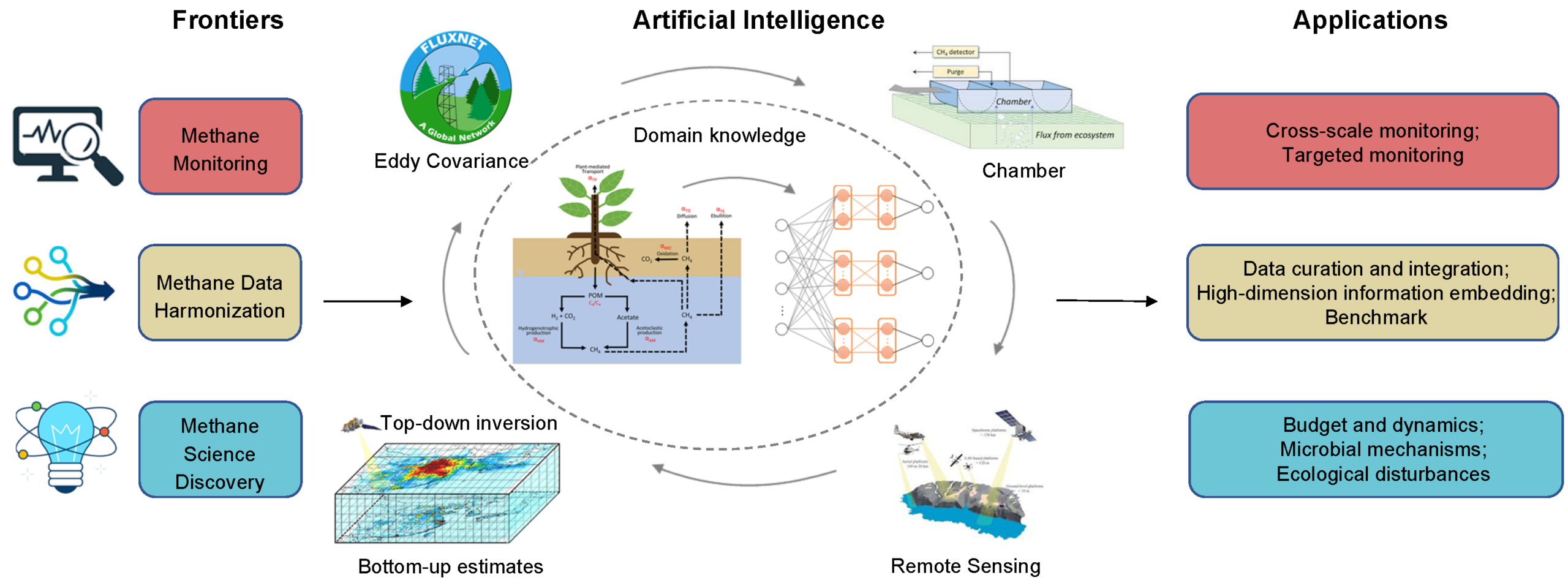
Improving the estimation and understanding of global CH4 sinks and sources within natural and agricultural ecosystems, with the goal of supporting GHG mitigation strategies. This research will leverage multidisciplinary collaboration and the harmonization of observational and synthetic datasets from various emission sectors, utilizing advanced AI-engaged tools. We aimto develop KGML-engaged framework for CH4 sink and source estimations across different ecosystems, addressing both historical and future scenarios. This effort will build on the AI4NM benchmark data and public datasets such as FLUXNET-CH4. The outcomes will refine global CH4 budget estimations, reducing key uncertainties and enhancing the effectiveness of GHG mitigation strategies. Leading efforts can also be found in AI for Natural Methane (AI4NM) working group https://cu-esiil.github.io/AI-for-Natural-Methane/